3 August 2023 Grazing and robot milking: are they compatible?
Many dairy farmers do not find grazing and robot milking an ideal combination. But are they really incompatible? And what options are available if you want to try it? We asked Neeke van Zwol, dairy farmer on Terschelling, how she approaches it.
Out in the fields in summer
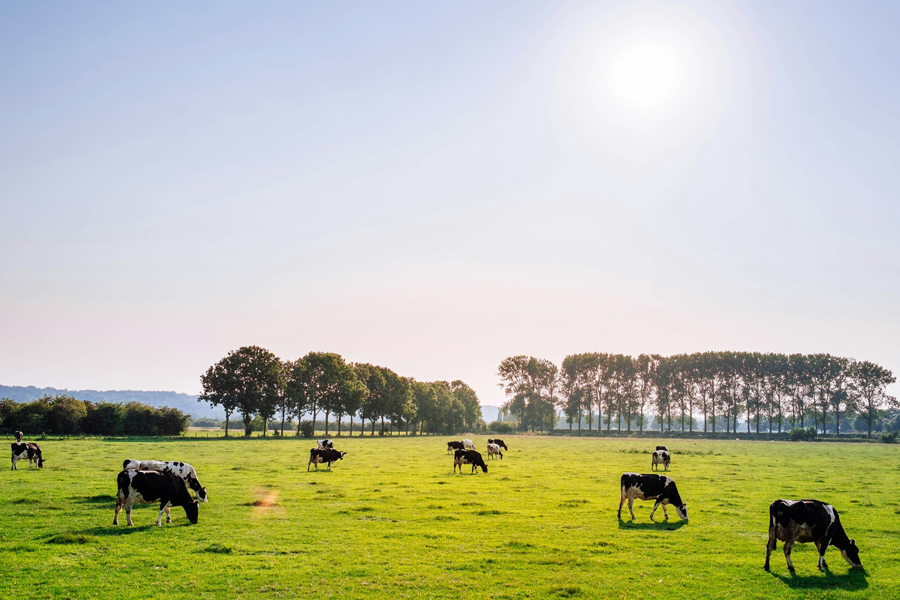
As a dairy farmer, you want to get things right on your farm. You ensure a comfortable barn, nice bedding, good feeding areas and an efficient milking system. And if at all possible, your animals go out into the fields.
For Neeke van Zwol, organic farmer on Terschelling, grazing is very important. ‘I don’t know any better. My father used to always take the cows outside and I have kept that up on my farm. I have cows with very few hoof and udder problems and am convinced that the outdoor life has a positive effect on their health.’
The ambition: robot milking
On the other hand, as a dairy farmer, you also want to get things right for yourself and having one less thing to do is often very welcome. The same goes for Neeke who switched to robot milking in November 2022. ‘I had a 50-year-old milking parlour, so it badly needed replacing,’ she says. ‘Milking was just taking up too much of my time, so I started looking for another solution.’
Robot milking was at the top of Neeke’s list, but to combine this with grazing she had to think carefully about how best to arrange the barn and the process. Neeke: ‘I didn’t want to have to keep an eye on the cows all day to make sure they were milked on time and then got outside again. The idea, of course, was to reduce my work’.


The right motivation
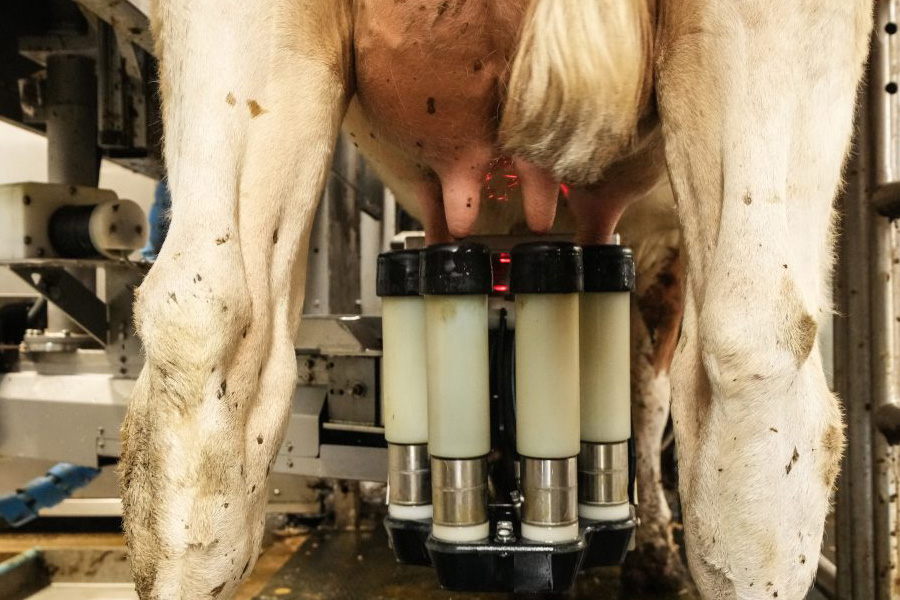
Neeke made a conscious choice to position the Merlin 2+ milking robot at the back of the barn. ‘When the cows come in from the pasture, they don’t have to go through the whole barn before reaching the robot,’ she explains. ‘Once they are milked, they are led onto the pasture through the front door of the robot and a corridor a bit further away. That means they are not tempted to go straight back into the barn through the back door. My Fullwood dealer BoschHIT was very constructive about how I could give the cows a push in the right direction. Very helpful, because generally now they go straight back out into the field.’
‘Incidentally, it also helps that I always offer them a new piece of pasture after milking,’ Neeke continues. ‘A clean plate is an extra incentive for them. The advantage is that my plots are favourably situated and not too big. I only need to move a few wires to guide the cows to another piece of land. I can imagine that is not as easy for every farmer.’
Making adjustments
Still, the combination of robot milking and grazing is quite possible, Neeke believes. ‘It may simply be that you have to make a few adjustments. You might need to make the plots smaller to keep the pathways clear or think about the placement of the robot. Or you can use sensors that allow you to decide which cows can or cannot go outside.’
Neeke has never had to use these sensors herself. ‘The placement of the robot and setting it up correctly mean that the robot can fully determine for me whether a cow can go outside or not,’ she explains. ‘So I didn’t have to buy extra gates, which saved me money!’
Raising and letting go
Neeke thinks it is important to raise her cows, but on the other hand she also wants to let things run their own course. ‘You shouldn’t be constantly looking over your cows’ shoulders,’ she says. ‘That’s no good for anyone. But they do have to learn what is expected of them.’
‘This method works very well here, in any case. An additional benefit is that milking speed has improved and the somatic cell count has fallen. This is because the cows are milked more often and better using the robot. This was never one of my goals, but it is absolutely a great bonus.’
Want to know more?
Would you like to learn more about the capabilities of our milking robots?